East Valley Real Estate FAQs, Tips & Community News

Whether you're buying your first home in Gilbert, selling in Chandler, or exploring new construction in Queen Creek or San Tan Valley, you've come to the right place. This resource hub is designed to answer the most common real estate questions we hear from Arizona buyers and sellers — and to keep you informed with the latest local market insights and community news across the East Valley.

Frequently Asked Questions About East Valley Real Estate

Is now a good time to buy a home in the East Valley?

The East Valley — including Gilbert, Chandler, Mesa, Queen Creek, and San Tan Valley — remains one of the most desirable real estate markets in Arizona. While market conditions shift, working with a local agent ensures you get current data on home prices, inventory, and interest rates specific to your target neighborhood.

How do I know what my East Valley home is worth?

Home values in the East Valley vary by community, lot size, upgrades, and recent comparable sales. A free Comparative Market Analysis (CMA) from a local real estate professional is the most accurate way to determine your home's current market value.

What are the best neighborhoods in Gilbert and Chandler for families?

Gilbert and Chandler consistently rank among the safest and most family-friendly cities in Arizona. Popular master-planned communities, top-rated schools, parks, and easy freeway access make both cities a top choice for relocating families and move-up buyers.

How long does it take to buy or sell a home in Arizona?

In Arizona, most residential transactions close within 30–45 days of an accepted offer. Selling timelines vary based on pricing, condition, and current market demand. Browse our latest articles below for up-to-date guidance on buying and selling in today's East Valley market.

Scroll down to explore our latest blog posts, local market updates, and expert real estate tips for the East Valley.

July 16, 2026

New Construction vs. Resale in Queen Creek (2026)

Is New Construction or Resale a Better Deal in Queen Creek in 2026?

In 2026, Queen Creek builders are running some of the most aggressive incentives in three years — rate buydowns near 5.25%, closing-cost credits of $10,000 to $30,000, and design allowances across roughly 18 active builders. But those headline numbers don't always mean new construction wins. Once you add lot premiums, upgrades, landscaping, and the Community Facilities District (CFD) tax that many new Queen Creek and San Tan Valley communities carry, a well-kept resale home in an established neighborhood often lands at a lower total cost. The right choice comes down to running the full monthly number on both, not just comparing sticker prices.

By Megan & Jason Williams | July 14, 2026


This is one of the questions we field most from buyers relocating to the East Valley right now. You're scrolling listings, you see a shiny new build in Queen Creek with a builder ad promising a rate in the 4s, and right next to it sits a five-year-old resale home in Power Ranch or Morrison Ranch for a similar price. Which one actually costs less to own?

Here's the honest answer we give every client: it depends on the total number, and the total number is almost never the base price the builder quotes you.

Let's break down how to compare the two the right way.

What Queen Creek's 2026 market looks like

The Queen Creek market shifted through the first half of 2026. Inventory climbed sharply off its winter lows, and by mid-year the area was sitting in a balanced-to-warm range — roughly 3.4 months of supply, where 4 to 6 months is considered fully balanced. That means sellers still have a slight edge, but buyers have far more room to negotiate than they did a year ago.

New construction is a big part of that story. Queen Creek and neighboring San Tan Valley have an active builder pipeline — around 18 builders and close to 500 available homes at various stages. Median new-build prices have been running in the $640,000 to $665,000 range, with homes averaging 90-plus days on market. When homes sit that long, builders get motivated, and that's exactly why the incentives are so strong right now.

Resale is a different picture. Established East Valley neighborhoods like Gilbert's have a tighter land supply and less new inventory, so prices have held firmer — Gilbert's median has hovered near $580,000. You'll typically find shorter days on market on well-priced resale homes, which means less negotiating leverage but also a home that's already broken in. If you're weighing the cash side of either path, our breakdown of closing costs for buyers in Gilbert and Queen Creek walks through exactly what to budget beyond the price.

The builder incentives are real — and worth understanding

We won't pretend the new-construction incentives aren't attractive. As of mid-2026, builders like Toll Brothers, Meritage, D.R. Horton, and Shea are running:

  • Rate buydowns — some down to around 5.25%, and a few offering 4.99% through a 3-2-1 temporary buydown where the builder prepays part of your interest for the first three years
  • Closing-cost credits — commonly $10,000 to $30,000, often tied to using the builder's preferred lender
  • Design and upgrade allowances — dollars you can apply toward flooring, countertops, or other finishes
  • Appraisal fee waivers and occasional small rate concessions through the in-house lender

On a $700,000 build, those incentives can add up to real money. The catch is that most of them are tied to financing through the builder's lender, so you'll want to compare that lender's total cost — rate plus fees — against an outside lender before you assume the incentive is a pure win. If new construction is where you're leaning, start with our current list of new construction homes for sale in Queen Creek.

Where new construction gets more expensive than the sticker

This is the part builders don't put on the sign, and it's where we spend the most time with buyers.

Lot premiums. The base price is for a base lot. A larger lot, a corner, a view, or backing to open space can add anywhere from a few thousand to $50,000 or more.

Upgrades. Model homes are loaded with upgrades. The base home has builder-grade finishes. Getting to the look you saw in the model — flooring, cabinets, countertops, a finished kitchen — often adds tens of thousands.

Landscaping. Many Queen Creek builders deliver the front yard but leave the backyard as dirt. Landscaping a backyard in Arizona — grass or turf, irrigation, pavers, maybe a ramada — can run $15,000 to $40,000 and up.

Window coverings, appliances, and fencing are sometimes extra too, depending on the builder.

A resale home, by contrast, usually comes with all of that already done and already priced in. That's the single biggest reason resale often beats new construction on total cost, even when the base prices look identical.

The CFD tax most new-build buyers don't see coming

If you take one thing from this post, make it this one.

Many newer communities in Queen Creek and San Tan Valley sit inside a Community Facilities District (CFD). A CFD is a special taxing district — authorized under Arizona law since 1988 — that funds the roads, water infrastructure, and parks for that development. The cost shows up as an extra line on your property tax statement under the Special District section, on top of your base property tax.

That assessment can add anywhere from a few hundred to a few thousand dollars a year, and the rate can change year to year depending on the district's debt service. On a monthly basis, a CFD can quietly add $100 to $300-plus to your housing payment — money that never shows up in the base price comparison.

Resale homes in older, established neighborhoods usually don't carry a CFD, or carry a much smaller one that's nearly paid off.

Before you sign anything on a new build, ask the builder's rep to put the full annual property tax plus any CFD assessment in writing. If they hesitate, that tells you something.

Don't skip your own inspection on a new build

A common assumption is that brand-new means problem-free. It doesn't. Construction defects, grading issues, and installation errors show up regularly in new Arizona homes, and the city inspector and the builder's inspector don't work for you.

We tell every new-construction buyer to budget for an independent inspection — ideally a pre-drywall inspection and a final walkthrough inspection before closing. Then schedule one more at the 10-to-11-month mark, while the builder's one-year workmanship warranty (required under Arizona's Registrar of Contractors rules) is still active. That last inspection is your window to get defects fixed on the builder's dime before the warranty expires.

Have your own agent — especially at the builder's sales office

The friendly person at the builder's model home works for the builder. They're good at their job, and their job is to represent the seller.

When you walk into a builder's sales office, bring your own buyer's agent — or at least register with one first. A buyer's agent who knows the builder contracts can help you understand the upgrade cost structure, push on incentives, review the CFD and tax disclosures, and make sure your inspection contingencies are handled. In most cases the builder pays that agent's commission out of their marketing budget, so it costs you nothing to have someone in your corner.

So which one should you choose?

Run both as a total monthly payment, not a base price:

  1. Base price + realistic lot premium + realistic upgrades + backyard landscaping for the new build
  2. Property tax + any CFD assessment — get it in writing
  3. HOA dues for both (master-planned communities on both sides carry these)
  4. The real financing cost — builder lender incentive vs. an outside lender's rate and fees
  5. Move-in readiness — a resale home is livable day one; a new build may need thousands in finishing before it feels done

When you stack those side by side, the "better deal" usually becomes obvious for your specific situation. Some buyers value the warranty, the layout, and the newness enough to pay the premium — and that's a fine choice when you go in with eyes open. Others realize a resale home two miles away gives them the same square footage, a finished yard, and a lower payment.

Frequently Asked Questions

Are builder rate buydowns in Queen Creek actually worth it?

They can be, especially the temporary 3-2-1 buydowns that lower your payment for the first few years. Just compare the builder's preferred-lender rate and fees against an outside lender, because the incentive is usually tied to financing in-house. The buydown is only a win if the overall loan cost is competitive.

What is a CFD tax and how much does it add in Queen Creek?

A Community Facilities District (CFD) is a special assessment that funds infrastructure in newer developments, added on top of your base property tax. In Queen Creek and San Tan Valley new-build communities it can add several hundred to a few thousand dollars a year, or roughly $100 to $300-plus per month. Always ask the builder for the full tax and CFD figure in writing before you commit.

Do I need a home inspection on a brand-new house in Arizona?

Yes. New construction still has defects, and neither the city inspector nor the builder's inspector represents you. Get an independent inspection before closing and another around the 11-month mark while the builder's one-year workmanship warranty is still active.

Is new construction or resale cheaper in Queen Creek right now?

It depends on the total cost, not the base price. New builds carry lot premiums, upgrades, backyard landscaping, and often a CFD tax that resale homes in established neighborhoods usually don't. Once you add those in, a comparable resale home frequently costs less to own month to month.

Should I use my own agent when buying from a builder?

Absolutely. The builder's sales rep represents the builder, not you. A buyer's agent — whose commission the builder typically covers — can help you compare incentives, review disclosures, and protect your inspection and financing contingencies.


New construction and resale can both be smart buys in Queen Creek right now — the trick is comparing the real total cost of each, CFD tax and all, instead of the numbers on the sign. That's exactly the kind of side-by-side we run with our clients before they ever write an offer.

If you want us to build that comparison for a specific home or community, no pressure and no pitch, we'd love to help. Reach out to Megan & Jason Williams and let's run the numbers together.

About Megan & Jason Williams
Megan & Jason Williams are a husband-and-wife REALTOR® team with 18 years of experience and 700+ homes sold across the Phoenix East Valley. Based in Gilbert, Arizona, they specialize in helping relocation buyers and out-of-state families find the right home in Gilbert, Queen Creek, Chandler, and surrounding communities — with the no-BS, straight-talk approach you'd expect from people who made the move themselves. Reach them at 480-618-1890 or Megan@Mail.HomeInfoAZ.com.

Posted in Buyer Tips
June 30, 2026

Home Insurance Costs in Gilbert & Queen Creek (2026)

Home Insurance Costs in Gilbert & Queen Creek (2026)

How much is homeowners insurance in Gilbert and Queen Creek, AZ?

Expect to pay about $2,300 to $4,500 a year to insure a single-family home in the $700,000 to $1,500,000 range in Gilbert or Queen Creek in 2026. Arizona premiums have climbed roughly 62% over the past five years — the steepest rise of any state — driven by higher rebuild costs, a skilled-labor shortage, and monsoon wind and hail claims. Your lender requires an active policy before closing, and most buyers pay the first full year upfront at the closing table.

By Megan & Jason Williams | June 30, 2026

You found the house. You ran the mortgage numbers. Then your lender hands you an insurance quote that's $800 higher than you expected — and suddenly your monthly payment doesn't look the way you planned.

This is one of the fastest-rising questions we hear from buyers right now, especially families relocating to the East Valley who are comparing their old premium to an Arizona one. Home insurance has gone from a line item nobody thought about to a number that can change which house you can afford.

Here's what's actually happening with insurance costs in Gilbert and Queen Creek in 2026 — and how to keep it from blowing up your budget at the closing table.

What home insurance actually costs here in 2026

Statewide, the average Arizona home insurance premium sits somewhere around $2,000 to $2,600 a year, depending on which survey you read. But that average is built on smaller, older homes across the whole state.

For the homes most of our buyers are looking at — single-family new builds and resales in the $700,000 to $1,500,000 range — you should plan for more. A realistic budget:

  • $700K–$900K homes: roughly $2,300–$3,200 a year
  • $900K–$1.2M homes: roughly $3,000–$4,000 a year
  • $1.2M–$1.5M homes: roughly $3,800–$4,500+ a year

The reason your premium tracks higher than a neighbor's smaller house is straightforward: insurance is priced on rebuild cost, not purchase price or Zestimate. A larger home with upgraded finishes costs more to rebuild after a fire or a major monsoon claim, so it costs more to insure.

These are budgeting ranges, not quotes. Your actual number depends on the home's age, roof, systems, your claims history, and your deductible.

Why Arizona premiums jumped so fast

If you bought a home here five years ago, your premium today would surprise you. Arizona home insurance rates have climbed about 62% over the past five years — the largest increase of any state in the country — and Arizona ranked among the top handful of states for rate spikes in the most recent national data.

A few things are driving it:

  • Rebuild costs are up. Construction materials and skilled labor both got more expensive, and there's a real shortage of tradespeople across the Valley. Rebuilding a home costs more than it did, so policies cost more.
  • Monsoon damage. High winds, hail, and blowing debris during Arizona's summer storms generate real claims every year, and insurers price that risk in.
  • Statewide loss trends. Wildfire exposure in parts of the state and broader national reinsurance costs push every Arizona homeowner's rate up, even in a lower-risk suburb.

The takeaway: this isn't a quirk of one carrier. It's a market-wide shift, and it's why the quote you remember from two years ago isn't the quote you'll get today.

Insurance is required before you close — and you pay upfront

Here's the part that catches relocation buyers off guard.

Your lender will not fund your loan without an active homeowners policy in place. Your insurance agent has to send Evidence of Insurance — an EOI — to both your lender and the title company before the close of escrow. No policy, no funding, no keys.

And you don't pay it monthly at first — you pay the first full year upfront at closing. On a $4,000 annual premium, that's $4,000 added to your cash to close, on top of your down payment and the rest of your closing costs.

After that first year, most buyers have insurance built into an escrow account — sometimes called an impound account. Your lender collects roughly one-twelfth of your annual premium and property taxes with each mortgage payment, holds it, and pays the bills when they come due. It keeps you from getting hit with one giant insurance bill once a year, but it also means your monthly payment is bigger than just principal and interest.

If you want to see how insurance fits with taxes, HOA, and the rest, we broke the full picture down in our guide to the monthly cost to own a home in Gilbert, and how it all lands at signing in our buyer closing costs breakdown for Gilbert and Queen Creek.

How insurance quietly changes what you can afford

This is the part that matters most, and it's why we bring it up early with buyers instead of at the closing table.

Lenders qualify you on your total monthly housing payment — principal, interest, taxes, and insurance, which the industry shortens to PITI. When the insurance piece jumps by $1,000 or $1,500 a year, that's another $80 to $125 a month inside your payment. That can move your debt-to-income ratio enough to shrink your maximum loan, or push the home you wanted just out of reach.

It works the other way too. Two similar homes — one with a newer roof and a recent HVAC system, one with a 16-year-old roof and aging systems — can carry very different premiums, and one may be harder to insure at all. In a balanced market where you have room to negotiate, the condition of those big-ticket systems is worth real money.

How to keep your premium under control

You have more control here than most buyers think:

  1. Shop at least three quotes. It's fine to start with your lender's or agent's referral, but compare. Premiums for the same home can vary by hundreds of dollars between carriers.
  2. Ask about the roof and HVAC before you write the offer. In Arizona, tile roof underlayment dries out and cracks around 15 to 20 years, and AC units typically last 12 to 15 years. Older systems mean higher premiums — or coverage headaches.
  3. Mind your deductible. A higher deductible lowers your premium, but make sure you can cover it out of pocket after a monsoon claim.
  4. Bundle with auto when it makes sense — many carriers discount meaningfully for it.
  5. Get the quote early, before your inspection period ends. That way an ugly premium is information you can act on while you still have negotiating room, not a surprise on your closing statement.

That last point is the whole game. Insurance is one of the hidden carrying costs buyers miss — right alongside the CFD tax surcharges in some Queen Creek subdivisions — and the buyers who come out ahead are the ones who price it in before they fall in love with the house.

Frequently Asked Questions

How much is homeowners insurance on a $1 million home in Gilbert or Queen Creek?

Plan for roughly $3,000 to $4,000 a year for a $1 million single-family home in 2026, though your exact premium depends on the home's rebuild cost, roof age, systems, and your deductible. Premiums are based on what it costs to rebuild the home, not the purchase price.

Do I have to pay home insurance before closing in Arizona?

Yes. Your lender requires an active policy and Evidence of Insurance sent to the lender and title company before the close of escrow, and you typically pay the first full year upfront at closing. After that, it's usually collected monthly through your escrow, or impound, account.

Why is Arizona home insurance so expensive now?

Arizona premiums have risen about 62% over the past five years — the largest increase of any state — driven by higher construction and labor costs, monsoon wind and hail claims, and broader statewide loss trends. It's a market-wide shift, not a single carrier raising rates.

Does home insurance affect how much house I can afford?

Yes. Lenders qualify you on your full payment including taxes and insurance, so a higher premium raises your monthly housing cost and can lower your maximum loan amount. A $1,500 jump in annual premium adds roughly $125 to your monthly payment.

Is flood insurance required in Gilbert or Queen Creek?

Standard homeowners policies don't cover flood, and most East Valley homes outside a designated flood zone aren't required to carry it — but some are, depending on the parcel. Your lender will tell you if your specific property sits in a flood zone that calls for separate coverage.

Don't let insurance surprise you at the table

Rising insurance is one more reason the smartest move in this market is to know your full carrying cost — not just your mortgage rate — before you write an offer. Get the quote early, price it into your budget, and there are no surprises on closing day.

If you want to talk through what this looks like for your specific situation — no pressure, no pitch — we'd love to help. Book a quick call with Megan & Jason and let's go over your home goals together.


About Megan & Jason Williams
Megan & Jason Williams are a husband-and-wife REALTOR® team with 18 years of experience and 700+ homes sold across the Phoenix East Valley. Based in Gilbert, Arizona, they specialize in helping relocation buyers and out-of-state families find the right home in Gilbert, Queen Creek, Chandler, and surrounding communities — with the no-BS, straight-talk approach you'd expect from people who made the move themselves. Reach them at 480-618-1890 or Megan@mail.homeinfoaz.com.

June 29, 2026

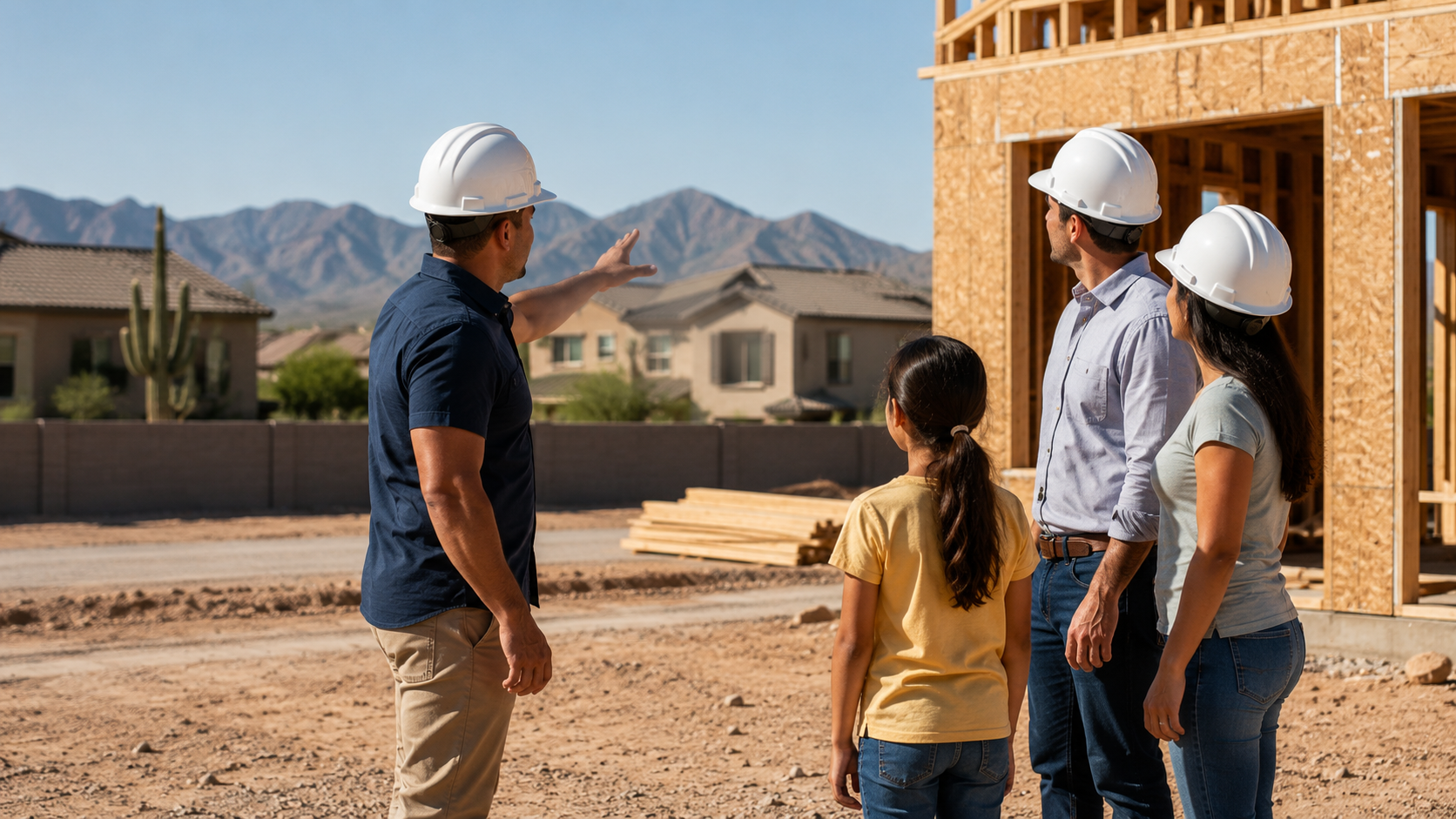
What You Can (and Can't) Negotiate on a New Construction Home in Gilbert & Queen Creek

What You Can (and Can't) Negotiate on a New Construction Home in Gilbert & Queen Creek

What can East Valley buyers negotiate on a new construction home in 2026?

In the Gilbert and Queen Creek new construction market, base price is off the table — but that's not where the real money is anyway. With 18 active builders competing for buyers across Queen Creek's 905+ listing pipeline in June 2026, you can negotiate rate buydowns to around 5.25%, closing cost credits up to $25,000, lot premium reductions, design center allowances, and extended rate locks. Knowing exactly where builders will flex — and where they won't — is how you get the best deal on a new build without walking away empty-handed.

By Megan & Jason Williams | June 29, 2026

The on-site sales rep at that model home is friendly, knowledgeable, and genuinely helpful. They are also paid by the builder to close deals at the highest price with the fewest concessions.

That's not a criticism — it's just the reality. And understanding it changes how you walk into every builder conversation.

Here's what you actually need to know before you sign on that dotted line.

The One Thing Builders Protect: Base Price

Builders in Gilbert and Queen Creek almost never reduce the base price of a home. Not because they can't — because they won't.

Here's why: Every home sale in a community becomes a comp. If a builder cuts $30,000 off the base price for you, that sale price shows up in the appraisal data for every future home in the development. That can drag down values across their entire inventory and make it harder to justify pricing on the next phase.

So when a builder says "we can't negotiate on price," they're being truthful. The base price is locked.

But that's a much smaller piece of the total deal than most buyers realize.

Where Builders Compete Hard

This is where the 2026 market is telling you something. Queen Creek alone has 18 active builders and over 900 homes available — the largest inventory in three years. Gilbert is effectively land-locked, with most remaining new construction limited to final infill parcels. Both markets have shifted toward buyers in a meaningful way.

That means builders need your business more than they did in 2022. The tools they use to compete are real, and they're aggressive:

Financing incentives. This is where the actual negotiating happens. Toll Brothers, Meritage, and D.R. Horton have been running rate buydowns to around 5.25% and closing cost credits up to $25,000 on select communities. The catch: these incentives typically require you to use the builder's preferred lender. More on that in a moment.

Lot premium reductions. Every builder charges extra for premium lots — corner lots, cul-de-sacs, larger footprints, views, or backing to open space. In a slower sales environment, those premiums have room to move. We've helped buyers in Ironwood Crossing and newer Queen Creek communities negotiate lot premiums down by $5,000–$15,000 when the builder had multiple similar lots they needed to move.

Design center credits. Builders love selling upgrades at the design center because margins are steep — often 2–3x what you'd pay post-close. A granite-to-quartz upgrade that runs $8,000 at the design center might cost $4,500 if you handled it after closing. Ask for a design center credit as part of your deal rather than paying full retail.

Extended rate lock periods. If you're building from the ground up, construction can take 6–12 months. Ask the builder to extend your rate lock protection — some will absorb the cost of a longer lock as part of the overall incentive package.

Appliance packages. Many builders will add a refrigerator, washer/dryer, or upgraded appliance suite rather than reduce base price. It's not cash in hand, but it's money you won't spend after closing.

Closing timeline flexibility. Builders with completed spec homes sitting unsold are highly motivated to close quickly. If you can move fast, that's leverage worth using.

Understanding what's included — and what's not — in a new build is also part of your closing cost picture. For a full breakdown of what East Valley buyers pay at the table, see our post on buyer closing costs in Gilbert and Queen Creek in 2026.

Spec Homes vs. Dirt Builds: Where You Have the Most Room

Not all new construction negotiations are equal.

Spec homes — also called inventory homes or quick move-ins — are the builder's most negotiable product. A finished or near-finished home sitting unsold costs the builder carrying costs and tied-up capital every single day. The longer it sits, the more motivated they become — especially near end of quarter.

On a spec home in Queen Creek right now, it's realistic to stack multiple incentives in a single deal: a rate buydown, a closing cost credit, and an appliance package all at once. That's a very different conversation than a base-price cut, but the dollar value can be just as significant.

Dirt builds — homes you contract before construction starts — give you more personalization but less negotiating leverage. The builder has time and the flexibility to find another buyer if you push too hard. You can still negotiate lot premiums and financing terms, but don't expect them to stack incentives the way they would on a spec.

The Timing Play Most Buyers Don't Know About

Builders operate on quarterly sales targets. The last two weeks of each calendar quarter — late March, late June, late September, and late December — are when builder sales teams are hungriest to close deals and hit their numbers.

A builder's rep facing a quota shortfall on June 28th is a completely different conversation than that same rep on July 2nd when the quarter just reset and the pressure is off.

If you're flexible on timing and can go under contract or close near end of quarter, make that known. It's real leverage — and most buyers never think to use it.

What to Watch Out For at the Design Center

The design center appointment happens early in the process and can easily add $50,000–$100,000 to your purchase price if you walk in without a strategy.

A few things to keep in mind:

The base price doesn't include much. Expect standard-grade carpet, basic cabinets, and entry-level counters. Builders deliberately price the base home low so it looks affordable — the design center is where they build their margin back in.

Some upgrades are worth paying for; most are not. Structural upgrades — an extra bedroom, an extended covered patio, a walk-in pantry — are harder and more expensive to add after the fact. Cosmetic upgrades like tile, carpet, counters, and light fixtures can usually be done post-close for significantly less.

Get the design center credit negotiated before you walk in. If you can secure a $10,000–$15,000 design center allowance as part of your purchase deal, you're spending the builder's money, not yours.

Why You Need a Buyer's Agent Before Your First Model Home Visit

If you walk into a new construction community without a buyer's agent and then later decide you want one, you may have waived your right to representation — depending on how the builder's registration policy reads.

This matters because builders allow buyer's agents and have every financial incentive not to remind you that you need one. The on-site sales agent represents the builder, period.

Your agent can review the builder's contract — which is not the standard AAR (Arizona Association of REALTORS®) purchase contract and is drafted entirely in the builder's favor — negotiate on your behalf, and compare incentive packages across competing communities. When you're deciding between a $900,000 Toll Brothers home and an $860,000 Meritage home with $25,000 in credits plus a rate buydown, you need someone who can run those numbers side by side without a conflict of interest.

We've walked dozens of clients through new construction purchases in Gilbert, Queen Creek, and Chandler. The process looks simpler than it is until you're at the design center committing to $80,000 in upgrades or trying to figure out why the builder's contract has an arbitration clause buried in paragraph 14.

For a deeper look at why agent representation matters so much in new construction, read why you don't want to go solo when buying new construction in Arizona.

And if you're still weighing whether new construction or resale makes more sense for your situation, our breakdown of new construction vs. resale in Gilbert and Queen Creek walks through both options side by side — including how builder incentives change the true cost comparison.


Frequently Asked Questions

Do builders in Gilbert and Queen Creek negotiate on base price?

Rarely. Builders protect base price because every completed sale becomes a comp for future homes in the same community — a price cut on one home can affect appraisals across the entire development. They prefer to compete on financing incentives, closing cost credits, and lot premiums instead.

Can I bring my own real estate agent when buying new construction in Arizona?

Yes, and you should register your agent before your first visit to a model home. Once you visit without one, most builders consider you an unrepresented buyer and their policies may prevent adding representation later. Your agent reviews the builder's contract (not the standard AAR form), negotiates incentives, and compares competing communities — all at no cost to you as the buyer.

What's the best time to negotiate with a builder in Gilbert or Queen Creek?

The last two weeks of each calendar quarter — late March, late June, late September, and late December — when builders are closing out quarterly sales targets. Spec homes sitting unsold for 60–90+ days are also considerably more negotiable than new contracts on homes that haven't broken ground yet.

Are builder incentives better than using my own lender?

Not always. Builder financing incentives like rate buydowns and closing cost credits are typically tied to using the builder's preferred lender. Before committing, get a competing quote from an independent lender. If the builder's preferred rate is 5.25% but your own lender can offer 5.5% with no restrictions and lower fees, run the total cost math — not just the rate comparison.

What should I be careful about at the design center?

Going in without a budget. Design center upgrades typically carry 2–3x the markup you'd pay for the same work after closing. Cosmetic items — flooring, counters, fixtures — are usually better done post-close. Structural upgrades like an extra bedroom, covered patio extension, or larger garage are worth considering at the design center because they're genuinely harder and more expensive to add later.


Navigating new construction in Gilbert and Queen Creek in 2026 is nothing like it was two years ago. Builders are competing for buyers, inventory is up, and incentive packages are real — but the contract is still drafted in the builder's favor and the design center is still designed to add up fast.

If you want to talk through what this looks like for your specific situation — no pressure, no pitch — we'd love to help. Book a quick call with Megan & Jason at FindAZValleyHomes.com and let's go over your home goals together.


About Megan & Jason Williams
Megan & Jason Williams are a husband-and-wife REALTOR® team with 18 years of experience and 700+ homes sold across the Phoenix East Valley. Based in Gilbert, Arizona, they specialize in helping relocation buyers and out-of-state families find the right home in Gilbert, Queen Creek, Chandler, and surrounding communities — with the no-BS, straight-talk approach you'd expect from people who made the move themselves. Reach them at 480-618-1890 or Megan@mail.homeinfoaz.com.

June 25, 2026

Queen Creek CFDs: The Property Tax Surcharge Buyers Miss

Queen Creek CFDs: The Property Tax Surcharge Buyers Miss

What is a CFD in Queen Creek, AZ, and how does it affect what you pay in property taxes?

A Community Facilities District (CFD) is a special taxing district that funds roads, water lines, drainage systems, and parks in newer subdivisions. In Queen Creek, many homes — especially in master-planned communities built after 2000 — carry a CFD assessment that adds hundreds to thousands of dollars per year on top of standard property taxes. It shows up as a line item in the "Special Districts" section of your Maricopa or Pinal County tax bill. Most buyers don't know it's there until they're already in escrow.

By Megan & Jason Williams | June 25, 2026

Here's a conversation we have more often than you'd think.

A buyer finds a home they love in Queen Creek. The listing shows property taxes of $4,200 a year. They do their payment math, they feel good about the numbers, and they make an offer. Then, a week into escrow, their lender runs the full parcel tax history — and the actual annual tax obligation is closer to $6,000. The difference is a CFD the buyer never knew existed.

This isn't a scam. It's not a mistake. It's just a piece of the Queen Creek real estate landscape that rarely gets explained upfront — and one that can meaningfully change your monthly cost of ownership if you're buying in the $700K–$1.5M range.

Here's what CFDs are, why Queen Creek has so many of them, and exactly how to find out whether the home you're considering carries one.

What Is a CFD, Exactly?

A Community Facilities District is a government-authorized financing mechanism. When a developer builds a new community — think large master-planned subdivisions with new roads, underground utilities, community parks, and drainage infrastructure — they often use CFD bond financing to front those costs rather than building them into home prices directly.

The CFD issues bonds. Infrastructure gets built. And then, over the next 20 to 40 years, homeowners in that subdivision pay off those bonds through an annual special assessment tacked onto their property tax bill.

It's not fraud. It's not hidden in the fine print of a predatory loan. It's a legitimate public finance tool — one that's common across Arizona's fast-growing suburbs. But it's also one that quietly adds to your total cost of ownership in a way that a listing price or a basic property tax search won't reveal.

Queen Creek has more CFDs than most East Valley cities for a simple reason: it grew fast, and that growth required a lot of infrastructure investment in a short period of time. Gilbert, by contrast, has been largely built out for years — most of its older CFDs have already expired or are in their final years. Queen Creek is still in the thick of it.

How Much Does a CFD Add to Your Property Taxes?

This is where buyers need to pay close attention, because the range is wide.

A CFD assessment in Queen Creek can run anywhere from a few hundred dollars to more than $2,500 per year, depending on the subdivision, the original bond amount, and how much of the debt has been retired. On a home you're buying for $800,000, that's a meaningful delta — the difference between a $500/year CFD and a $2,200/year CFD is nearly $150 per month in effective carrying cost.

When you're trying to budget your true monthly housing cost, that gap matters. Your lender will factor the full property tax obligation — including the CFD — into your debt-to-income ratio calculation. If the number comes in higher than you expected, it can affect your purchasing power.

Want to understand what your full monthly cost looks like on a $700K–$1M Gilbert home without a CFD? We broke down the complete stack — mortgage, taxes, HOA, insurance, and utilities — in our post on monthly costs to own a home in Gilbert, AZ. The Queen Creek version of that calculation needs to include the CFD.

Which Queen Creek Communities Have CFDs?

This is the part that trips people up. CFDs aren't assigned to the entire town of Queen Creek — they're specific to individual subdivisions, and they vary widely even within the same zip code.

Ironwood Crossing is one of the better-known Queen Creek communities with a CFD structure. It's a large established neighborhood that sits in the 85142 zip code and has seen steady resale activity. The community carries both HOA assessments and a CFD — and the combined annual tax obligation looks noticeably different from a Gilbert resale home with no special districts.

Newer master-planned communities still in active development — including some of the large communities currently underway in the northern Queen Creek area near the Switchyard district and near the LG Energy Solution manufacturing campus — are very likely to carry CFD financing as well. That infrastructure has to be funded somehow, and CFD bonds are the standard tool.

Older established Queen Creek neighborhoods, particularly those built before approximately 2000, are less likely to have active CFDs. If the bonds have been paid off, the line item either disappears from the tax bill or drops to a minimal ongoing maintenance fee.

The bottom line: you cannot assume a Queen Creek home does or doesn't have a CFD based on the neighborhood name or the listing price. You have to check the parcel-specific tax history.

If you're weighing Queen Creek versus Gilbert, this is one of the factors worth building into your comparison. We covered the bigger new construction vs. resale decision in detail in our guide on new construction vs. resale in Gilbert & Queen Creek.

How to Find Out If a Home You're Buying Has a CFD

You have three reliable ways to check:

Pull the parcel tax history from the county assessor. If the property is in the 85142 zip code, it's in Maricopa County — use the Maricopa County Assessor's website (mcassessor.maricopa.gov) and search by address. If the property is in the 85140 or 85143 zip codes, it may fall in Pinal County — check the Pinal County Assessor at pinalcountyaz.gov. Look for the "Special Districts" line on the tax detail. That's where CFD assessments appear. You want to see the most recent year's actual tax bill, not just the listed rate.

Review the SPDS. In Arizona, sellers complete the Seller's Property Disclosure Statement (SPDS) — pronounced "speeds" — which covers known assessments, HOA obligations, and special district charges. A thorough SPDS will flag a CFD. If the seller leaves that section blank and you know the community typically carries a CFD, ask your agent to get clarification in writing.

Ask your agent before you write the offer. This is the simplest one. Any experienced agent working the Queen Creek market should be able to pull parcel details in a few minutes and tell you what the real annual tax obligation is before you're emotionally invested in a home. This is exactly the kind of thing we walk our clients through on every Queen Creek showing.

One important nuance: the MLS-listed property tax figure for a Queen Creek home often reflects the base county rate only, or a blended number that doesn't isolate the CFD. It is not always accurate. Don't rely on it.

Also worth understanding: your closing costs and your first year's property tax proration at closing will both be based on the full tax obligation — CFD included. If you're planning your cash-to-close budget, factor the complete number in from the start.

The Queen Creek Calculation You Should Run Before Making an Offer

When you're evaluating a home in Queen Creek, here's the tax stack you need to understand:

Base county rate. For Maricopa County parcels, the primary tax rate is $1.1591 per $100 of assessed value — and the Board of Supervisors has held this flat for nine consecutive years. For Pinal County parcels, the base rate differs. Your agent or lender can confirm which county applies to the specific parcel you're considering.

School district levies. These are the largest component of your overall property tax bill in most East Valley communities — larger even than the county rate in many cases.

Special district assessments. This is the line that includes any CFD, municipal utility district, or improvement district charges. For many Queen Creek subdivisions, this is where the CFD lives.

Put all three together and you have your actual annual property tax obligation. On a $750,000 Queen Creek home in an active CFD community, don't be surprised if the real number runs $6,500–$8,000 per year or higher, depending on where that home sits within the taxing districts.

Compare that to what the full cost picture looks like in our breakdown of whether Queen Creek is the right move for buyers in 2026. The growth story there is real — the LG Energy plant, The Switchyard district, the job pipeline — but the cost of ownership needs to be in your model.

Frequently Asked Questions

What is a CFD in Queen Creek, AZ?

A Community Facilities District (CFD) is a special taxing district created to finance public infrastructure — roads, water lines, drainage, parks — in a new development. In Queen Creek, many newer subdivisions have CFDs that add an annual assessment to your property tax bill on top of the standard county base rate. It shows up in the "Special Districts" section of your tax bill and is not included in most MLS-listed tax figures.

How much does a CFD add to property taxes in Queen Creek?

CFD assessments vary by subdivision and outstanding bond balance. In active Queen Creek communities, charges typically range from $500 to $2,500+ per year. The only way to get the exact number for a specific home is to pull the full parcel tax history from the Maricopa or Pinal County Assessor — the MLS figure is often incomplete.

Do all Queen Creek homes have CFDs?

No. CFDs are specific to individual subdivisions, not the entire town. Older established neighborhoods built before approximately 2000 typically don't carry them. Newer master-planned communities — especially those that required significant infrastructure investment — are much more likely to have active CFD assessments. You have to check parcel by parcel.

How do I find out if a Queen Creek home has a CFD before I buy?

Pull the full parcel tax history from the Maricopa County Assessor (mcassessor.maricopa.gov) or Pinal County Assessor for homes in the 85140 or 85143 zip codes. The CFD charge appears in the "Special Districts" line. Also review the SPDS — the seller's disclosure — which should list known special assessments. And ask your agent to check this before you write an offer, not after.

How long does a CFD last in Arizona?

CFD bonds typically run 20 to 40 years depending on financing terms. Once the bond is paid off, the full CFD assessment ends — though a reduced maintenance fee may continue. Some Queen Creek CFDs are already in their final years; others in newer communities won't expire for decades. The age of the subdivision is the clearest signal of where a given CFD stands in its lifecycle.


CFDs aren't a reason to avoid Queen Creek. For buyers who understand the full picture — and price a home's value accordingly — it's a manageable piece of the cost stack. But it's one that needs to be in the calculation before you make an offer, not something you piece together in escrow.

If you want help running the numbers on a specific home — including pulling the parcel tax detail, comparing CFD exposure across neighborhoods, and understanding what you're actually paying month to month — we'd love to help. Book a quick call with Megan & Jason at FindAZValleyHomes.com and let's go over your home goals together. No pressure, no pitch — just straight answers about what a specific home is actually going to cost you.


About Megan & Jason Williams
Megan & Jason Williams are a husband-and-wife REALTOR® team with 18 years of experience and 700+ homes sold across the Phoenix East Valley. Based in Gilbert, Arizona, they specialize in helping relocation buyers and out-of-state families find the right home in Gilbert, Queen Creek, Chandler, and surrounding communities — with the no-BS, straight-talk approach you'd expect from people who made the move themselves. Reach them at 480-618-1890 or Megan@mail.homeinfoaz.com.

June 22, 2026

Closing Costs for Buyers in Gilbert and Queen Creek, AZ (2026)

Closing Costs for Buyers in Gilbert and Queen Creek, AZ (2026)

What are buyer closing costs in Gilbert and Queen Creek, AZ?

Buyers purchasing a home in Gilbert or Queen Creek typically pay 2%–4% of the purchase price in closing costs, plus prepaid expenses that add another $4,000–$8,000. On a $750,000 home, plan for $12,000–$24,000 in cash needed at closing, beyond your down payment. Arizona has no real estate transfer tax, which saves buyers thousands compared to most other states. All funds flow through the title and escrow company — no real estate attorney is required.

By Megan & Jason Williams | June 22, 2026

Closing costs are one of those numbers buyers hear about early, vaguely plan for, and then feel surprised by anyway. Here's why: the range is wide, several costs depend on your specific loan and community, and the timing catches people off guard.

If you're buying a home in the $700,000–$1.5M range in Gilbert or Queen Creek, you're looking at real money — not just a few hundred dollars. Getting a clear picture before you're two weeks from closing is how you avoid the scramble.

Here's exactly what you're paying for.

A Line-by-Line Look at What You're Paying

Closing costs in Arizona fall into a few distinct buckets. Some come from your lender. Some come from the title and escrow company. And some — the prepaids — aren't technically "fees" but cash you need to have ready anyway.

Lender fees cover the cost of processing your mortgage. Expect $3,000–$6,000 depending on your loan amount and lender. This typically includes an origination fee, underwriting and processing fees, and a credit report fee. Some lenders roll these into the rate; others charge them upfront. Ask for the Loan Estimate within three business days of your application — it breaks out every lender fee by line item.

Appraisal. Your lender requires an appraisal to confirm the home is worth what you're paying. Budget $600–$800 for a standard single-family home. On higher-end properties or homes with unusual features, it can run higher.

Inspections. A general home inspection runs $400–$650 in the East Valley. Most buyers in this price range add a roof inspection ($150–$250), a pool inspection if applicable ($150–$200), and a wood-destroying organism inspection for termites ($75–$150). Subterranean termites are common in Maricopa and Pinal counties — a termite inspection is not optional here. Budget $700–$1,500 total for inspections.

Title insurance (lender's policy). Arizona is an escrow state — closings are handled by title and escrow companies, not attorneys. In most East Valley transactions, the seller pays for the owner's title policy. You pay for the lender's title policy, which protects your lender's interest in the property. On a $750,000 purchase, that's roughly $900–$1,200.

Escrow and settlement fees. The title company charges a settlement fee to facilitate the closing. Budget $1,000–$2,000. This is typically split between buyer and seller, though it's negotiable in the contract.

Recording fees. Maricopa County and Pinal County charge small recording fees to officially document the deed. These run $15–$50 and are essentially negligible at this price range.

HOA transfer and initiation fees. This is where Gilbert and Queen Creek buyers get surprised. Most master-planned communities — Power Ranch, Morrison Ranch, Seville, Ironwood Crossing, Fulton Ranch — charge transfer fees, capital contribution fees, or initiation fees at closing. These vary significantly by community. Some are a flat $250–$500. Others, especially in Queen Creek, charge a capital improvement fee equal to 0.5% of the purchase price — that's $3,750 on a $750,000 home. Ask your agent to pull the HOA disclosure documents before you're under contract so you know what to expect.

Prepaids. These aren't fees — you're not paying them to anyone as a charge — but they're still cash you need at the table:

  • Homeowner's insurance (full year, paid upfront): $1,500–$3,000 in Arizona, depending on the home's value and coverage
  • Property tax reserves: Your lender collects several months of property taxes upfront to fund your escrow impound account. Maricopa County's effective rate runs roughly 0.8%–1.1% of assessed value. On a $750,000 home, annual taxes might run $4,500–$6,000 — so expect to prepay $1,500–$3,000 at closing
  • Prepaid mortgage interest: You pay interest from your closing date to the end of that month. Close earlier in the month, pay more. Close on the 28th, pay almost nothing. The per diem on a $600,000 loan at 6.5% is about $107 per day

What to Budget at Different Price Points

Every loan and community is different, but here's a realistic range for buyer closing costs — including prepaids — in the Gilbert and Queen Creek market at current rates.

On a $700,000 purchase with 20% down ($140,000 down), expect $11,000–$22,000 in closing costs and prepaids. Total cash to close: approximately $151,000–$162,000.

On a $900,000 purchase with 20% down ($180,000 down), expect $14,000–$27,000 in closing costs and prepaids. Total cash to close: approximately $194,000–$207,000.

On a $1,200,000 purchase with 20% down ($240,000 down), expect $17,000–$34,000 in closing costs and prepaids. Total cash to close: approximately $257,000–$274,000.

These figures assume 20% down, a conventional loan, an HOA community with typical fees, and a standard inspection package. Your actual number depends on your lender's fees, the specific community's HOA charges, and what you negotiate in the contract.

One important note: Arizona has no real estate transfer tax. The state eliminated it in 2008. Unlike California, Colorado, Florida, and dozens of other states where buyers or sellers pay a percentage of the sale price to the state or county at closing, Arizona's tab for that line item is $0. On a $750,000 home, a 0.5% transfer tax would cost $3,750. Here, it doesn't exist.

How to Reduce Your Closing Costs Without Lowering Your Offer

You have more options than most buyers realize.

Ask for seller concessions. In today's East Valley market, it's entirely reasonable to ask sellers to contribute $5,000–$15,000 toward your closing costs as part of the purchase contract. The seller's contribution reduces their net proceeds — it doesn't change the sale price on paper — which sometimes makes it easier for them to agree. In Queen Creek specifically, where homes are currently averaging 90+ days on market and price reductions are common, asking for concessions is standard. We broke down exactly how this works in our post on seller concessions in the East Valley in 2026.

Take advantage of builder incentives on new construction. Builders in Queen Creek's active pipeline — with 18 builders and roughly 455 available homes — are currently offering $10,000–$30,000+ in closing cost credits, rate buydowns, and design allowances. These aren't permanent. They change with inventory and market pressure. And they're most accessible when you have a buyer's agent negotiating on your behalf from day one.

Negotiate the escrow fee split. In most East Valley transactions, the escrow fee is split 50/50 between buyer and seller. This is negotiable. In a slower market, asking the seller to cover their half or even the full fee is reasonable — and it rarely kills deals at this price point.

Consider a lender credit. Some lenders offer credits toward your closing costs in exchange for a slightly higher interest rate. Whether that trade makes sense depends on how long you plan to stay in the home. Run the math before you accept: divide the total credit by the monthly payment increase to find your break-even point.

After your offer is accepted, you'll receive a Closing Disclosure at least three business days before closing showing every cost line by line. If you want to understand exactly what you'll see on that document — and everything that happens between contract and keys — our complete Arizona buyer timeline walks through the full escrow period step by step.

And if you're still in the early stages of deciding whether buying makes sense right now, the numbers in our renting vs. buying in Gilbert analysis factor in upfront acquisition costs alongside the monthly payment comparison — so you can see the full picture.

Every buyer's number is different. Your specific loan, your community's HOA, your lender's fee structure, and what you negotiate in the contract all move the needle. That's exactly why we walk through a detailed cost estimate with every buyer we work with before they make an offer — no surprises at the closing table.

Frequently Asked Questions

Do buyers pay closing costs in Arizona, or does the seller?

In Arizona, buyers pay their own closing costs — lender fees, title insurance (lender's policy), inspections, and prepaids. Sellers typically pay for the owner's title insurance policy, the listing agent's commission, and any concessions they've agreed to in the contract. Both parties pay portions of the escrow fee, though this is negotiable. Arizona has no transfer tax, so neither party pays that.

How much should I budget for closing costs on an $800,000 home in Gilbert or Queen Creek?

On an $800,000 home with 20% down, budget $12,000–$25,000 in closing costs and prepaids on top of your $160,000 down payment. HOA initiation or capital contribution fees — common in master-planned communities like Power Ranch, Morrison Ranch, and Ironwood Crossing — can add $500–$4,000 depending on the community. Your lender is required to provide a Loan Estimate within three business days of your application that breaks out every cost.

Does Arizona have a real estate transfer tax?

No. Arizona eliminated its real estate transfer tax in 2008. Neither buyers nor sellers pay a state or county transfer tax on the sale price. This is a meaningful advantage over states like California, Colorado, and Florida, where transfer taxes can add thousands to the closing table.

Can I get the seller to pay my closing costs in Arizona?

Yes. Seller concessions — where the seller contributes a set dollar amount toward your closing costs — are negotiable in the purchase contract. In the current East Valley market, asking for $5,000–$15,000 in concessions is reasonable, especially on homes that have been sitting 60+ days. Conventional loans cap seller concessions at 3–6% of the purchase price depending on down payment; FHA caps at 6%; VA caps at 4% plus closing costs.

When do I have to pay closing costs — all at once?

You pay closing costs at the closing table in one wire transfer. Your lender provides a Closing Disclosure at least three business days before closing showing your exact cash-to-close figure — that's your down payment plus all closing costs combined. The wire goes to the title and escrow company, which distributes funds to all parties after recording.


Closing costs on a $700K–$1.5M home in Gilbert or Queen Creek will run you $11,000–$34,000 above your down payment — depending on your loan, community, and what you negotiate. Knowing that number before you're deep in escrow is what separates a smooth closing from a stressful one.

If you want to talk through what this looks like for your specific situation — no pressure, no pitch — we'd love to help. Book a quick call with Megan & Jason at FindAZValleyHomes.com and let's go over your home goals together.


About Megan & Jason Williams
Megan & Jason Williams are a husband-and-wife REALTOR® team with 18 years of experience and 700+ homes sold across the Phoenix East Valley. Based in Gilbert, Arizona, they specialize in helping relocation buyers and out-of-state families find the right home in Gilbert, Queen Creek, Chandler, and surrounding communities — with the no-BS, straight-talk approach you'd expect from people who made the move themselves. Reach them at 480-618-1890 or Megan@mail.homeinfoaz.com.

June 17, 2026

The BINSR in Arizona: How to Negotiate Repairs After a Home Inspection

The BINSR in Arizona: How to Negotiate Repairs After a Home Inspection

What Is the BINSR and How Do Arizona Buyers Use It to Negotiate After a Home Inspection?

In Arizona, the BINSR — Buyer's Inspection Notice and Seller's Response — is the official AAR contract form buyers use to negotiate after a home inspection. Once your 10-day inspection period ends, you submit the BINSR to request repairs, a seller credit, a price reduction, or to cancel the contract and get your earnest money back. The seller has 5 calendar days to respond, and you then have 5 days to accept, counter, or walk away. Understanding how to use the BINSR strategically is one of the most important skills a buyer can have in the current East Valley market.

By Megan & Jason Williams | June 17, 2026

You got your inspection report. It's 60 pages long. There are 140 items flagged — some genuinely alarming, some the inspector noting that a light switch has a tiny scratch.

Now what?

This is where a lot of buyers either freeze up, overreact, or underreact — and it's where deals fall apart over things that didn't need to.

The BINSR is the tool that prevents all of that. It's the official form in the Arizona AAR contract — the same contract used for every residential purchase in Gilbert, Queen Creek, Chandler, and across the East Valley — that gives you a structured, legally grounded way to work through what you found.

Here's exactly how it works.

The Inspection Period: What You Have, and How Long You Have It

Under the standard Arizona AAR Residential Purchase Contract, you typically have 10 calendar days from contract acceptance to complete your inspections. That clock starts the day the contract is signed — not the day it's dated, not the day earnest money clears.

During those 10 days, you can bring in as many professionals as you want: a general home inspector, a pool inspector, a roof inspector, a structural engineer, a pest inspector, or a sewer scope technician. In Arizona, where HVAC systems typically last 12–15 years and pools require their own specialized review, using the full 10 days and hiring the right specialists is worth every dollar.

Not sure what inspectors actually look at? Our guide to home and pool inspections in Arizona covers what they check and what you should watch for during the walkthrough.

Once the inspection period ends, your right to cancel under the inspection contingency is gone. The BINSR must be submitted — or formally waived — before that deadline. This is not a soft deadline. Agents who miss it have put their clients in a very difficult position.

What You Can Ask for on the BINSR

This is where most buyers get confused. You have four options on the BINSR, and you can combine them:

Request repairs. You list specific items and ask the seller to fix them before closing. This is common but not always the best move — more on that below.

Request a credit at closing. Instead of asking the seller to make repairs, you ask them to contribute to your closing costs or reduce the net proceeds by a specific dollar amount, and you handle the repairs yourself after closing. This is often cleaner, especially for HVAC issues, roofing, or anything you'd want done differently than the seller would do it.

Request a price reduction. Less common, but available. You're asking to re-negotiate the purchase price based on what the inspection revealed. This works best when the issues are significant and you have contractor quotes to back up the number.

Accept the property as-is and proceed. You can use the BINSR to formally notify the seller that you're accepting the property in its current condition and moving forward. This clears ambiguity and keeps the timeline clean.

The one thing that trips buyers up: you cannot submit a laundry list of cosmetic items and expect a seller to take it seriously. The BINSR should be focused on material defects — things that affect habitability, safety, or structural integrity. A dripping faucet, a cracked outlet cover, and weeds in the backyard are not BINSR items. A failing HVAC unit, roof damage, foundation cracking, or a pool with equipment failures — those are.

If you've asked for a credit, get contractor quotes first. A written estimate makes your ask credible. "The inspector flagged the HVAC and I'd like $6,000" lands better than "I think the HVAC might be an issue." It also keeps the conversation from devolving into a standoff.

How the Response Process Works

Once you submit the BINSR, the seller has 5 calendar days to respond. They can agree to everything, counter-offer with something different, or decline entirely.

If the seller declines or counters with something you can't accept, you then have 5 calendar days to accept their response, submit a counter-BINSR, or cancel the contract and get your earnest money back.

Here's what most buyers don't realize: under the standard AAR contract, you have genuine leverage at this stage. As long as you cancel within the proper inspection period window, you get your earnest money back — no questions asked. Sellers know this. A reasonable seller will almost always engage in good faith during BINSR negotiations rather than risk losing the buyer entirely and starting over.

That leverage only works if you use it correctly — with a clear, reasonable BINSR that focuses on real issues. A BINSR that asks for 47 items including "re-caulk master bath" signals that you're a difficult buyer, not a serious one. That can make a seller defensive and less willing to negotiate even on the legitimate items.

For more on how the cancellation and earnest money refund process works in Arizona, see our full breakdown of the 4 ways to cancel and get your earnest money back.

BINSR Strategy in the East Valley Market Right Now

The current market in Gilbert, Queen Creek, and Chandler is meaningfully more buyer-friendly than it was in 2021 and 2022. Days on market are up — some homes in Queen Creek are sitting 60–90 days — seller concessions are back, and most sellers are motivated to keep deals together rather than relist and start over. That means the BINSR has real teeth right now.

In 2022, buyers were waiving inspection contingencies just to compete. Nobody is doing that today.

What we tell every buyer we work with: focus the BINSR on the highest-cost, highest-risk items. HVAC systems, roofs, pools, electrical panels, water heaters, structural concerns. Get quotes from licensed Arizona contractors. Use those quotes to frame your credit request. If you found $8,000 worth of documented issues, asking for a $6,500–$7,000 credit typically gets the deal done — the seller feels like they negotiated and you didn't leave money on the table.

If the inspection turned up something major — a failing roof at $18,000, a pool equipment rebuild at $5,000 — that changes the conversation. You may need a specialized inspection, a contractor estimate in writing, and a direct conversation about whether the price still makes sense at all. This is exactly the kind of situation where having a buyer's agent who knows this market makes a real difference.

If you're under contract on a new construction home in Queen Creek or Gilbert, the BINSR process still applies — but builders typically push repair requests back to their warranty team rather than agreeing to credits. The standard tactic is "we'll fix it under warranty after closing." That can be fine for minor items, but for anything that affects livability or is already visible at final walkthrough, get it in writing and documented before closing day.

One more thing: don't conflate BINSR negotiations with appraisal issues. If the appraisal comes in below the purchase price, that's a completely separate negotiation with different timelines and different tools. If you hit both — a tough inspection and a low appraisal — our guide on what Arizona buyers can do when the appraisal comes in low walks through your options.

What If the Seller Says No?

They can. And sometimes they do.

If you submitted a reasonable, well-documented BINSR and the seller still declines, you have a choice: accept the property as-is and proceed, or cancel and get your earnest money back.

The right answer depends on how much you want the home, how serious the issues are, and how the numbers look once you factor in post-closing repair costs. There's no universal rule. What matters is that you understand your options, your timeline, and what you're actually walking into.

We've been through this process with hundreds of buyers across Gilbert, Queen Creek, and Chandler over the last 18 years. Some BINSR negotiations are straightforward — the seller agrees, everyone moves on. Some turn into genuine decision points where the buyer has to ask hard questions about whether this deal still makes sense. The only way to navigate that well is to go in with a clear head and someone in your corner who's done it before.

Frequently Asked Questions

What does BINSR stand for in Arizona?

BINSR stands for Buyer's Inspection Notice and Seller's Response. It's the official Arizona Association of REALTORS® (AAR) form used in residential purchase contracts to formally document buyer repair requests and seller responses after a home inspection.

How long does the buyer have to submit the BINSR in Arizona?

In most Arizona AAR contracts, the buyer has 10 calendar days from contract acceptance to complete inspections and submit the BINSR. This deadline is written into the contract and cannot be extended after the fact without the seller's agreement.

Can the seller refuse to fix anything on the BINSR?

Yes. The seller can decline all repair requests. If that happens, the buyer can accept the property as-is, counter with a different request, or cancel the contract and receive their earnest money back — as long as the buyer is still within the inspection period window.

Should I ask for repairs or a credit on the BINSR?

In most situations, a closing cost credit is cleaner than asking for repairs. You get the money and hire your own contractor after closing — rather than relying on the seller to use a qualified contractor and complete the work before closing. Credits are especially useful for HVAC, roofing, and pool issues.

Does the BINSR apply to new construction in Arizona?

Yes, most new construction contracts include an inspection period and BINSR process. However, builders typically handle repair requests differently — often directing issues to their warranty program rather than agreeing to credits. This is one of the key reasons having a buyer's agent when purchasing new construction in Queen Creek or Gilbert matters.


The BINSR process sounds complicated on paper, but in practice it's a structured, time-limited negotiation that gives you real tools. Use them clearly and strategically, and most deals that hit a rough inspection come out the other side.

If you want to talk through what this looks like for your specific situation — no pressure, no pitch — we'd love to help. Book a quick call with Megan & Jason at FindAZValleyHomes.com and let's go over your home goals together.


About Megan & Jason Williams
Megan & Jason Williams are a husband-and-wife REALTOR® team with 18 years of experience and 700+ homes sold across the Phoenix East Valley. Based in Gilbert, Arizona, they specialize in helping relocation buyers and out-of-state families find the right home in Gilbert, Queen Creek, Chandler, and surrounding communities — with the no-BS, straight-talk approach you'd expect from people who made the move themselves. Reach them at 480-618-1890 or Megan@mail.homeinfoaz.com.

Posted in Buyer Tips
June 14, 2026

What to Negotiate When Buying New Construction in Gilbert & Queen Creek, AZ

What to Negotiate When Buying New Construction in Gilbert & Queen Creek, AZ


What to Negotiate When Buying New Construction in Gilbert & Queen Creek, AZ

What can you negotiate when buying new construction in Gilbert or Queen Creek, AZ?

When buying new construction in Gilbert or Queen Creek, Arizona, buyers can negotiate the base price (especially on inventory homes), lot premiums, builder-paid rate buydowns, upgrade credits, closing cost contributions, and third-party inspection rights. As of mid-2026, Queen Creek has over 450 new homes available from 18 active builders, giving buyers real leverage—if they know how to use it. The key is bringing your own buyer's agent before your first model home visit, understanding which homes have the most flexibility, and knowing what to ask for in writing.

By Megan & Jason Williams | June 14, 2026

Here's something the builder's sales office isn't going to volunteer: the person greeting you at the model home works for the builder. They're knowledgeable, friendly, and helpful—but they're contractually obligated to represent the builder's interests, not yours.

That doesn't mean you can't get a great deal on new construction in Gilbert or Queen Creek. It means you need to know what's negotiable, how to ask for it, and why having your own representation changes the entire dynamic.

We've helped hundreds of East Valley buyers purchase new construction homes across Gilbert, Queen Creek, Chandler, and the surrounding communities. Here's what's actually on the table.

The Queen Creek Pipeline and Why Leverage Exists Right Now

Queen Creek has one of the deepest new construction pipelines in the entire Phoenix metro. As of spring 2026, there are approximately 455 new construction homes available from 18 different builders. That's a significant inventory, and builders with homes sitting unsold are paying carrying costs every day those properties aren't closed.

Gilbert's situation is different. With limited land available, Gilbert sees far less new construction than Queen Creek—and what's available moves faster. If you're buying in Ironwood Crossing, Morrison Ranch, or another Gilbert community with new inventory, your window to negotiate may be shorter.

In Queen Creek—across communities like Seville, Eastmark-adjacent developments, and new builds near the San Tan Valley border—you have more options and more time. That changes what you can ask for.

The first rule: never walk into a model home without your buyer's agent registered first. Arizona's builder-broker code requires your agent to accompany you on your initial visit to a subdivision, or the builder can refuse to recognize their representation—meaning you'd lose the professional guidance you're entitled to at no extra cost.

What You Can Actually Negotiate

Not everything is flexible. But more is than you'd think.

Base price on inventory homes. Builders rarely drop the base price on presale (dirt) builds because it creates pricing inconsistencies across the subdivision. But on spec homes and quick move-ins that are already complete or near completion? The calculus changes. A builder carrying a finished home at $680,000 for three months may be willing to take $655,000 or stack significant incentives to close the deal.

Lot premiums. In any new construction community, certain lots command a premium—corner lots, cul-de-sacs, park-facing positions, or lots without neighbors directly behind. These premiums can range from $5,000 to $50,000 or more. On inventory homes or in slower-moving communities, builders will often waive or discount lot premiums entirely. It's one of the first things to ask about.

Mortgage rate buydowns. This is where we're seeing the most action in 2026. Several Queen Creek builders are offering permanent rate buydowns on quick move-in homes, with rates as low as 4.99%—well below current market rates. A 2/1 temporary buydown reduces your rate by 2% in year one and 1% in year two. On a $600,000 loan at 6.5%, dropping to 4.5% in the first year saves you roughly $600 per month.

Builders prefer to offer rate incentives through their preferred lenders. That's worth understanding: their lender isn't required to give you the best overall terms. Compare the builder's lender offer against your own financing options before you commit.

Upgrade credits. Flooring, cabinet finishes, appliance packages, countertops—the design center is where builders make significant margin. If you'd rather have closing cost credits than premium countertops, ask. If you want the upgrades, ask what they'd cost after-market versus what the builder is including. Your agent can help you assess whether an upgrade package adds real value at resale or is primarily a lifestyle spend.

Closing cost contributions. Builders routinely offer closing cost credits, especially when interest rates make monthly payments a sticking point. In East Valley communities in mid-2026, the average seller or builder concession is running around 2% of the purchase price. On a $650,000 home, that's $13,000 toward your closing costs—which can meaningfully reduce what you need to bring to the table at closing.

Independent inspection rights. New construction homes have defects. Framing issues, HVAC installation problems, improper grading—these aren't common, but they happen, and a builder's warranty doesn't always resolve them quickly. Make sure your contract allows for an independent home inspection before closing and ideally a pre-drywall inspection during construction. Don't sign away this right.

The Costs Builders Don't Lead With

Before you compare builders on base price, you need to understand the full cost of entry into a new construction community.

Capital improvement fees. Many master-planned communities in Queen Creek, Chandler, and Gilbert—including Eastmark, Ironwood Crossing, and Power Ranch—charge a one-time capital improvement fee at closing. This typically runs 0.5% to 1% of the purchase price and funds the HOA's community reserve. On a $650,000 home, that's $3,250 to $6,500 due at closing, on top of your other closing costs. Ask before you fall in love with a community.

HOA dues. Morrison Ranch in Gilbert runs around $429 per quarter. Power Ranch neighborhoods vary but tend to be in a similar range. New communities often start with lower dues that increase as amenities come online. Factor the HOA cost into your monthly payment calculation from the start.

Landscaping. New construction homes in Arizona almost always transfer with a blank-slate backyard. Landscaping costs in the East Valley run $8,000 to $30,000 or more depending on lot size, trees, patio, and artificial turf versus natural grass. Budget for it. Some buyers use the builder's upgrade budget on landscaping credits or negotiate with the builder to do the front yard, at minimum.

Pinal County vs. Maricopa County taxes. Some Queen Creek homes fall in Pinal County rather than Maricopa County. Pinal County's effective property tax rate runs slightly higher—approximately 0.72% versus 0.62% in Maricopa. On a $650,000 home, the annual difference is about $650. Not a dealbreaker, but worth knowing when you're comparing two communities that look similar on paper.

How to Work This Process

Register your buyer's agent before stepping into any model home. This protects your representation rights from day one and costs you nothing—builders pay the buyer's agent commission.

Ask for the full incentive sheet in writing before your first visit. Incentives change constantly, and what's offered today may not be available next week. Get it in writing so you have a baseline to negotiate from.

Focus your negotiating energy on inventory and quick move-in homes. These have the most flexibility on price, lot premiums, and stacked incentives. If you're willing to close in 30 to 60 days, you have leverage—use it.

Compare total monthly cost, not just the base price. A builder offering a $620,000 base with a 4.99% permanent rate buydown and a waived lot premium may pencil out better on a monthly basis than a $595,000 base at current market rates with no incentives. We run this math for our clients before they ever sign a contract.

When you're buying in Queen Creek, Gilbert, or anywhere in the East Valley, the builders are experienced at what they do. Having someone in your corner who's walked through this process hundreds of times—and who knows how these deals get structured—changes the outcome.

Frequently Asked Questions

Do I need a buyer's agent for new construction in Arizona?

Yes—and it costs you nothing extra. In Arizona, builders pay the buyer's agent commission, so you get professional representation at no additional cost. The builder's on-site sales rep works for the builder, not you, and is contractually obligated to protect the builder's interests. Having your own agent means you have someone reviewing the contract, negotiating on your behalf, and advising on lot selection, upgrade value, and resale potential.

Can I negotiate the price on a new construction home in Gilbert or Queen Creek?

Yes, especially on inventory and spec homes that are already complete or nearly finished. Builders are highly motivated to move these homes since finished inventory carries ongoing costs. On dirt builds—homes you contract before construction starts—builders are less likely to reduce the base price, but you can still negotiate lot premiums, closing cost credits, and upgrade packages.

What is a rate buydown and how much can it save me?

A rate buydown is when the builder pays to temporarily or permanently lower your mortgage interest rate. A 2/1 buydown reduces your rate by 2% in year one and 1% in year two before settling at the note rate. On a $600,000 loan, a builder-paid buydown from 6.5% to 4.5% in year one can save you $400–$600 per month. As of mid-2026, several Queen Creek builders are offering permanent buydowns to rates as low as 4.99% on quick move-in homes.

What is the difference between a spec home and a dirt build in Arizona new construction?

A spec home is a home the builder has already started or finished without a specific buyer under contract. These offer faster move-in timelines—sometimes 30 to 60 days—and the most negotiating leverage. A dirt build is when you contract with the builder before construction starts. You get more customization options but wait 6 to 12 months for completion, and the builder has less financial pressure to negotiate on price.

What is a capital improvement fee and do new construction communities in Queen Creek charge it?

A capital improvement fee is a one-time charge the buyer pays at closing to fund the HOA's community reserve. In master-planned communities across Queen Creek, Chandler, and Gilbert—including Eastmark, Ironwood Crossing, and Power Ranch—this fee runs 0.5% to 1% of the purchase price. On a $650,000 home, that's $3,250 to $6,500 due at closing on top of standard closing costs. Always ask about this before you sign.


New construction in Queen Creek and Gilbert offers real value—builder incentives, energy-efficient builds, and modern floor plans that resale homes can't match. But the deals go to buyers who know what to ask for and have someone in their corner who's done this before.

If you're thinking about new construction in Gilbert, Queen Creek, Chandler, or anywhere in the East Valley, we'd love to walk you through what's available and what's actually negotiable right now. Reach out to Megan & Jason Williams and let's take a look at your options together—no pressure, no pitch, just straight talk about what makes sense for your situation.


About Megan & Jason Williams
Megan & Jason Williams are a husband-and-wife REALTOR® team with 18 years of experience and 700+ homes sold across the Phoenix East Valley. Based in Gilbert, Arizona, they specialize in helping relocation buyers and out-of-state families find the right home in Gilbert, Queen Creek, Chandler, and surrounding communities—with the no-BS, straight-talk approach you'd expect from people who made the move themselves. Reach them at 480-618-1890 or Megan@mail.homeinfoaz.com.

Posted in Buyer Tips
June 10, 2026

After Your Offer Is Accepted in Arizona: The Complete Buyer Timeline

After Your Offer Is Accepted in Arizona: The Complete Buyer Timeline


After Your Offer Is Accepted in Arizona: The Complete Buyer Timeline

What happens after your offer is accepted in Arizona?

After your offer is accepted in Arizona, you'll open escrow with a title company, deliver your earnest money within 1 business day, and move through a 30–45 day process covering inspections, appraisal, loan underwriting, and closing. Most financed purchases in Gilbert, Queen Creek, and Chandler close in 35 days under the standard AAR (Arizona Association of REALTORS®) purchase contract. The first 10 days are the most critical — that's your inspection window, and most of your cancellation rights live there.

By Megan & Jason Williams | June 10, 2026

Getting an offer accepted feels incredible. For about five minutes.

Then the questions start. What do we do now? When do we get the keys? What if something goes wrong? What does "in escrow" actually mean?

This is one of the most common places buyers in Gilbert, Queen Creek, and Chandler feel completely lost — not because the process is complicated, but because nobody walks them through it step by step. Your agent should. Your lender should. But if they haven't, here it is.

Arizona uses an escrow-based closing system. There are no real estate attorneys at the closing table — a title/escrow company handles the transaction from contract to close. That's actually one of the cleaner systems in the country, and once you know the timeline, it's remarkably predictable.

Here's exactly what happens after your offer is accepted.

Day 1–3: The Clock Starts Running

The purchase contract becomes binding the moment both parties sign. From that moment, multiple clocks start at once.

Earnest money is due within 1 business day. Your deposit — typically 1–3% of the purchase price for a $700K–$1.5M home in the East Valley — goes to the title company, not the seller. It sits in an escrow account and gets applied to your closing costs when you close. If you have a valid reason to cancel within your contingency windows, you get it back. If you back out without cause after your contingencies expire, the seller can keep it.

The seller has 3 days to deliver the SPDS. That's the Residential Seller's Property Disclosure Statement — a 9-page document where the seller discloses everything they know about the property: condition, repairs, HOA issues, roof age, water intrusion history, permit status. Read it carefully. If something in the SPDS is concerning, flag it before your inspection period ends.

Your lender gets to work immediately. The signed contract goes to your lender, who orders the appraisal and moves your file into underwriting. There's no waiting for inspections to finish before the appraisal gets ordered — both happen in parallel.

Days 1–10: The Inspection Period

This is the most important window in your entire transaction.

Arizona's standard AAR contract gives you a 10-day inspection period (from the contract date) to investigate the property however you choose. This is when you schedule your general home inspection, any specialty inspections — pool, roof, sewer scope, HVAC — and review everything the inspector flags.

A typical home inspection in Arizona runs $300–$500. Add $75–$125 for a termite inspection (required for most loan types), and $100–$200 if there's a pool. Budget $600–$900 for a complete inspection package on a home in the $700K–$1.5M range.

During those 10 days, you have a few choices:

Proceed as-is. You've reviewed everything and you're comfortable. You move forward without requesting anything.

Submit a BINSR. That's the Buyer's Inspection Notice and Seller's Response — Arizona's formal mechanism for requesting repairs, credits, or a price reduction based on inspection findings. The seller has 3 days to respond: they can agree to the request, make a counteroffer, or decline entirely. If they decline and you can't reach a resolution, you can cancel and get your earnest money back.

Cancel. If you discover issues that change the deal for you, you can cancel any time before the 10-day window closes and get your earnest money back — no questions asked.

After day 10, your inspection contingency expires. You're committed unless something changes with financing or the appraisal.

One thing we tell every buyer: Don't skip the inspection to win a bidding war. In today's more balanced Gilbert and Queen Creek market, you almost never have to. Seller concessions — including repair credits — are back on the table in 2026.

Days 7–21: Appraisal and Underwriting Run in Parallel

While you're in your inspection window, your lender has already ordered the appraisal. Appraisals in the Phoenix East Valley typically take 7–10 business days to complete from the order date.

The appraisal has one job: confirm the home is worth what you agreed to pay. If it comes in at or above your purchase price, it clears your financing and you move on. If it comes in low — meaning the appraiser values the home below your contract price — you have options: pay the gap in cash, renegotiate the price with the seller, challenge the appraisal through a Reconsideration of Value (ROV), or, if your contract includes an appraisal contingency, cancel. We covered low appraisals in detail here if that's a concern for your situation.

Underwriting is happening at the same time. Your lender's underwriter is reviewing your income, assets, debt, and the property itself. They may come back with "conditions" — requests for additional documentation like a letter explaining a gap in employment, updated bank statements, or clarification on a large deposit. Respond to these quickly. Delays at this stage are the most common reason closings get pushed.

If your file is clean and your documents are in order, underwriting typically issues a "clear to close" by day 20–25.

Days 25–35: Final Countdown

Once you're clear to close, a few things happen in quick succession.

You'll receive your Closing Disclosure (CD) at least 3 business days before closing. This document shows your final loan terms, exact monthly payment, and an itemized breakdown of every closing cost. Read it carefully and compare it to your Loan Estimate from when you first applied. If anything looks significantly different, ask your lender before closing day.

Title work gets finalized. The title company confirms the property has a clean title — no outstanding liens, judgments, or ownership disputes. They'll also prepare the deed and all transfer documents.

Your final walkthrough. Usually 24–48 hours before closing. This is your chance to verify the home is in the same condition as when you made your offer, and that any agreed-upon repairs from the BINSR have been completed. Go in with your inspection report. Check the HVAC, run the water, test the appliances, and make sure nothing was damaged during the seller's move-out.

Closing Day

On closing day, you'll head to the title company — or in many East Valley transactions, you'll sign documents electronically in advance and just wait for the call.

You'll sign a stack of loan documents (this takes 45–60 minutes for most buyers), and you'll bring your closing funds. Wire the money ahead of closing day if possible — title companies won't accept personal checks above a certain threshold. Your funds need to be in the title company's escrow account before recording can happen.

Once the title company receives all signed documents and your funds clear, they send everything to the county recorder's office. Recording is what makes you the legal owner. In Maricopa and Pinal counties, recording typically happens same-day.

Once recording is confirmed — usually within a few hours — you get the keys.

From accepted offer to keys in hand: 30–45 days for most financed purchases. Cash deals can close in 10–14 days.

Frequently Asked Questions

How long does it take to close on a house in Arizona?

Most financed purchases in Arizona close in 30–45 days from the accepted offer date. The standard AAR purchase contract targets a 35-day close, though lenders sometimes need more time if there are underwriting conditions to resolve. Cash deals can close in as few as 10–14 days.

What is the inspection period in Arizona and how long do I have?

Arizona's standard purchase contract gives buyers a 10-day inspection period starting from the contract date. During this window, you can hire inspectors, review the results, request repairs via a BINSR (Buyer's Inspection Notice and Seller's Response), or cancel for any reason and receive your earnest money back.

What is the SPDS in Arizona real estate?

The SPDS (Residential Seller's Property Disclosure Statement, pronounced "speeds") is a 9-page form the seller must complete and deliver within 3 days of contract acceptance. It covers property condition, known defects, HOA information, permit history, and more. Reviewing it carefully before your inspection period ends is critical.

Can I cancel after an offer is accepted in Arizona?

Yes — but your options narrow as contingencies expire. During the 10-day inspection period, you can cancel for any reason and get your earnest money back. After that, you can still cancel if the appraisal comes in low (assuming your contract includes an appraisal contingency) or if your financing falls through. Once all contingencies have expired, canceling typically means forfeiting your earnest money. Learn more about getting your earnest money back here.

What happens if the appraisal comes in low in Arizona?

If the appraisal comes in below the purchase price, you have four options: pay the difference in cash, renegotiate the price with the seller, submit a Reconsideration of Value (ROV) to challenge the appraisal, or cancel the contract if your appraisal contingency is still active. Which path makes sense depends on the gap amount, your financial position, and how motivated the seller is. Most experienced East Valley agents have navigated this dozens of times.


Every step in this timeline runs smoother when you have a lender who communicates and an agent who's managing the deadlines. We've closed hundreds of transactions in Gilbert, Queen Creek, and Chandler — and the ones that go sideways almost always come down to missed deadlines, slow document responses, or surprises that could have been caught earlier.

If you want to talk through what your specific timeline looks like, what to watch for in your inspection, or how to position yourself if the appraisal is a concern — no pressure, no pitch — we'd love to help. Book a quick call with Megan & Jason at FindAZValleyHomes.com and let's go over your home goals together.


About Megan & Jason Williams
Megan & Jason Williams are a husband-and-wife REALTOR® team with 18 years of experience and 700+ homes sold across the Phoenix East Valley. Based in Gilbert, Arizona, they specialize in helping relocation buyers and out-of-state families find the right home in Gilbert, Queen Creek, Chandler, and surrounding communities — with the no-BS, straight-talk approach you'd expect from people who made the move themselves. Reach them at 480-618-1890 or Megan@mail.homeinfoaz.com.

Posted in Buyer Tips
May 30, 2026

Low Appraisal in Arizona: What Buyers Can Do in 2026

Low Appraisal in Arizona: What Buyers Can Do in 2026

What happens when an appraisal comes in low in Arizona?

When the appraised value comes in below the purchase price in Arizona, you typically have four options: pay the gap out of pocket, renegotiate the purchase price with the seller, challenge the appraisal with a formal Reconsideration of Value, or cancel the contract and recover your earnest money under the appraisal contingency. In the 2026 East Valley market — where sellers in Gilbert, Queen Creek, and Chandler are working harder to get deals across the finish line — renegotiation is the most common path, and buyers now have real leverage to use it.

By Megan & Jason Williams | May 30, 2026

You just got the appraisal back, and the number is lower than your purchase price. Your phone lights up with a message from your lender. Your stomach drops.

First, take a breath. This happens more than most people realize — and in Arizona, you have real options. Low appraisals are disruptive, but they're not deal-killers unless you let them be.

Here's exactly what's happening, what you can do about it, and how we walk our clients through it.

Why Appraisals Come In Low

An appraiser's job is to verify that the home is worth what your lender is about to loan money against. They pull recent comparable sales — homes that closed within the last few months in the same area, similar size, similar condition — and use those to establish value.

The problem: the market sometimes moves faster than the data.

In a rising market, the most recent comps might be from transactions that closed 60–90 days ago — before prices ticked up. The appraiser isn't wrong. They're doing their job. But the number they land on reflects yesterday's market, and you negotiated based on today's.

In a balanced or cooling market — which is where much of the East Valley is in 2026 — you can see the opposite: buyers stretched to win in early 2025, and now the comps are catching up in a way that doesn't support what they agreed to pay.

Either way, you're left with an appraisal gap: the difference between the appraised value and your purchase price.

What the Arizona Contract Actually Says

Arizona uses the AAR (Arizona Association of REALTORS®) purchase contract, and it includes an appraisal contingency by default on all financed transactions. This is your protection.

Here's the short version: if the home doesn't appraise at or above the purchase price, your lender will only finance the appraised value. You can't just ignore the gap — your loan won't cover it.

Once you receive the appraisal report, the clock starts. Under the AAR contract, you have a set number of days to decide how to proceed. Work with your agent to understand your exact timeline, because missing it can cost you your options.

Your 4 Options When the Appraisal Comes In Low

Option 1: Pay the appraisal gap out of pocket

Your lender will lend against the appraised value. The rest — the gap between appraised value and purchase price — has to come from you.

Say you agreed to pay $850,000 for a home in Morrison Ranch, and the appraisal comes in at $820,000. Your lender bases the loan on $820,000. The remaining $30,000 gap is on you.

Some buyers include an appraisal gap guarantee clause in their offer to signal they'll cover a gap up to a certain amount. In a competitive situation, this can strengthen an offer. In 2026's East Valley — where days on market are running 50+ days and sellers need to close — you're less likely to need that clause upfront. But it still comes up on well-priced, move-in-ready homes in Power Ranch and Seville.

Option 2: Renegotiate the purchase price

This is the most common resolution in the current market, and it's where good representation makes a real difference.

You (through your agent) go back to the seller and make the case: the appraisal came in at $820K, and the deal needs to be restructured. The seller can agree to drop the price to the appraised value, meet you in the middle, or hold firm.

In 2026, most East Valley sellers are going to work with you. With homes sitting 50+ days on average and roughly 830 active listings in Queen Creek's 85142 zip code alone, sellers can't afford to restart. They'll price the loss — especially if re-listing means another 60 days and a potential second low appraisal.

When you renegotiate, you're not just after a price reduction. You can also ask the seller to cover more of your closing costs as part of the restructured deal. Here's a breakdown of what seller concessions look like in today's East Valley market — useful context before that conversation.

Option 3: Challenge the appraisal with a Reconsideration of Value

It's called a Reconsideration of Value (ROV), and it's harder than it sounds — but sometimes worth pursuing.

You submit a formal request to your lender (not the appraiser directly) with your supporting case. A strong ROV includes:

  • Factual errors in the appraisal (wrong square footage, missing rooms, incorrect bedroom count)
  • Comparable sales the appraiser didn't use — specifically, closings within the last 30–60 days at higher prices
  • A written explanation from your agent or the listing agent supporting why those comps apply

The appraiser is not required to change their opinion. But if your case is solid and backed by data, a correction or adjustment is possible. Lenders are required to forward ROV requests to the appraiser, and the appraiser must respond in writing — so there's a paper trail either way.

This path makes the most sense when you genuinely believe the appraiser missed something: a recent comp that closed higher, a factual error in the report, or a comparable sale that's more relevant than what they used.

Option 4: Cancel the contract and recover your earnest money

If you can't reach agreement and you don't want to cover the gap, you have the right to cancel.

Under the AAR contract's appraisal contingency, a low appraisal is a legitimate basis for cancellation — and your earnest money comes back to you. The key is timing. You must act within the contingency window spelled out in your contract. Here's a detailed breakdown of how Arizona buyers recover their earnest money when canceling.

This outcome protects you. You're not trapped. But walking away means starting over — back to zero in the same market that just produced the low appraisal. We always exhaust renegotiation first before recommending this path.

How Often Does This Happen in the $700K–$1.5M Range?

Low appraisals are more common than most buyers expect at the higher price points — and that's not an accident.

In the $700K–$1.5M range in Gilbert, Queen Creek, and Chandler, each home is more unique. You might have only one comparable sale within a mile from the past three months, at a meaningfully different price per square foot. The appraiser has to make judgment calls — and not every judgment call lands in your favor.

Thin comp pools mean more appraiser discretion. More appraiser discretion means more exposure on price if you've pushed above market.

This is why we stress pricing discipline with every offer our clients make. A strong offer doesn't mean an overpriced offer. There's a real cost to stretching above what the market will support — not just in appraisal risk, but in how the deal comes apart if it goes wrong.

What to Do Before the Appraisal Happens

The best time to think about appraisal risk is before you agree to a price.

On every offer, we walk our clients through a pricing stress test: given the recent comps in this neighborhood, what's the appraisal risk if we offer X? Sometimes the answer is: it'll appraise fine, the comps are strong. Sometimes it's: you're exposed for $40K if you go that high, and here's why.

That conversation is part of what a good buyer's agent does in this market. It's not just about getting an offer accepted — it's about protecting you through the whole transaction.

If you're relocating to the East Valley and managing this process from another state, that kind of local insight matters even more. We've helped buyers close in Queen Creek and across the East Valley without being here in person — and the appraisal is one of the conversations where having experienced local representation makes a tangible difference.

The 2026 Difference

A low appraisal in 2026 is a different conversation than it was in 2021.

In 2021, sellers had all the leverage. A low appraisal meant the buyer either paid the gap or lost the house to the next offer in line — and there was always a next offer. Most buyers waived appraisal contingencies just to compete.

Now, with 50+ day average market times across the East Valley and sellers actively cutting prices to get deals done, the power balance has shifted. If your appraisal comes in low, you have a real negotiating position. You're not begging the seller to meet you halfway — you're presenting them with a market reality they already knew existed.

Use that position. That's what it's there for.


Frequently Asked Questions

What happens if the appraisal comes in low and I have an appraisal contingency in Arizona?

Under the AAR purchase contract, an appraisal contingency gives you the right to cancel the contract and recover your earnest money if the home doesn't appraise at or above the purchase price. You must act within the contingency window specified in your contract — missing that deadline can limit your options. Talk to your agent the same day you receive the appraisal report.

Can I negotiate the price down after a low appraisal in Arizona?

Yes. Renegotiating the purchase price to match the appraised value is the most common resolution in the East Valley market. In 2026's balanced market, most sellers would rather adjust the price than lose the deal and re-list, so buyers have real leverage when an appraisal comes in short.

What is a Reconsideration of Value and how do I request one in Arizona?

A Reconsideration of Value (ROV) is a formal written request — submitted through your lender, not directly to the appraiser — asking the appraiser to review specific comparable sales or factual errors they may have missed. Your agent should put together the supporting data: recent closed comps that support a higher value, and any factual corrections to the report. Appraisers are not required to change their opinion, but they are required to respond in writing.

How much is an appraisal gap at the $700K–$1M price point in Gilbert or Queen Creek?

Appraisal gaps in the $700K–$1M range in Gilbert, Queen Creek, and Chandler typically run $15,000–$60,000 when they occur, depending on how stretched the original offer was and how thin the comp pool is. The fewer comparable sales in the area, the more discretion the appraiser exercises — and the more exposure you have on price.

Can the seller refuse to lower the price after a low appraisal in Arizona?

Yes, sellers can refuse to renegotiate. If that happens, you're left choosing between paying the appraisal gap out of pocket, challenging the appraisal with a Reconsideration of Value, or canceling the contract under your appraisal contingency. In today's East Valley market, outright refusal is less common than it was in 2021–2022 — most sellers would rather work out a compromise than restart the listing.


A low appraisal isn't a dead end — but how you handle it matters. The right move depends on your specific numbers, your position in the contract, and where the market is in the neighborhood you're buying in.

If you want to talk through what this looks like for your specific situation — no pressure, no pitch — we'd love to help. Book a quick call with Megan & Jason and let's go over your home goals together.


About Megan & Jason Williams
Megan & Jason Williams are a husband-and-wife REALTOR® team with 18 years of experience and 700+ homes sold across the Phoenix East Valley. Based in Gilbert, Arizona, they specialize in helping relocation buyers and out-of-state families find the right home in Gilbert, Queen Creek, Chandler, and surrounding communities — with the no-BS, straight-talk approach you'd expect from people who made the move themselves. Reach them at 480-618-1890 or Megan@mail.homeinfoaz.com.

May 27, 2026

Should You Buy in Queen Creek, AZ in 2026?

Should You Buy in Queen Creek, AZ in 2026?

Should you buy in Queen Creek, Arizona in 2026?

For buyers choosing between Queen Creek and Gilbert, 2026 is a pivotal year. Queen Creek is the fastest-growing town in Arizona — with a $120 million downtown district opening mid-year, 2,800+ manufacturing jobs coming from LG Energy Solution, and median home prices around $640,000–$685,000 that still undercut many comparable Gilbert options. Meanwhile, Gilbert is effectively land-locked: limited new construction, tightening resale inventory, and few entry points in the $700K–$1.5M range with builder incentives attached. If you're relocating to the East Valley or upgrading from a smaller home, the 2026 data points toward Queen Creek as the better buy — but the window before prices fully reflect these changes is narrowing.

By Megan & Jason Williams | May 27, 2026

Queen Creek has always been the "next Gilbert" — cheaper, newer, farther out. For years, that was both the pitch and the knock.

That story just changed.

In the last 18 months, three things happened that permanently shifted how buyers should think about Queen Creek versus the rest of the East Valley:

  • The $120 million Switchyard mixed-use district broke ground, bringing Queen Creek its first walkable downtown — Shake Shack, Postino, Snooze, and 215 luxury apartments opening in phases through 2026.
  • LG Energy Solution began ramping up its Queen Creek battery manufacturing plant, with 2,800+ jobs expected when fully operational — making it one of the town's largest employers.
  • Gilbert ran out of land. New construction in Gilbert is now largely constrained to infill lots, with builders targeting high-end custom projects on whatever sites remain.

Put those three things together, and Queen Creek in 2026 isn't just the cheaper option. It's the East Valley's growth story — and it's still priced like the East Valley's afterthought.

What's Actually Driving Queen Creek's Growth Right Now

The Switchyard is the piece buyers keep underestimating. It's not just a development — it's Queen Creek's first real downtown. Ten acres at the corner of Ellsworth and Ocotillo roads, with 54,000 square feet of restaurant and retail space, a luxury apartment component, and Phase 1 on track for mid-2026. When Postino and Snooze open in a suburb, surrounding home values move. That's been the pattern in every East Valley revitalization zone over the past decade.

LG Energy's manufacturing plant tells a parallel story. The facility is roughly 60% complete and hiring for initial positions now. When fully operational — likely late 2026 — it creates 2,800 direct jobs, with predictable downstream effects on housing demand. Major employers attract workers. Workers need housing. Housing close to the employment base gets more competitive.

U.S. News & World Report named Queen Creek the #1 best city to live in Arizona for 2025–2026. That's not a real estate press release — that's a national ranking that drives relocation buyer searches. The families moving from California, Colorado, and the Midwest are no longer looking only at Chandler and Gilbert. Queen Creek is on the shortlist now.

The town's population is approximately 84,000 today and is projected to reach 150,000 at full build-out. That's not speculative growth. It's backed by permitted infrastructure, active development, and a construction pipeline that's still early in its arc.

Why Gilbert's Build-Out Changes the Math for Buyers

Here's the part buyers coming from out of state often miss: Gilbert is essentially full.

The town's desirable location — close to the Chandler Tech Corridor, well-connected to the 202, established with restaurants and infrastructure — made it the dominant East Valley buy for two decades. That success is now its constraint. The large undeveloped tracts that once produced new master-planned communities are gone. What's left are infill lots and edge-of-town properties that command premium prices for what they are.

In May 2026, Gilbert's median list price sits around $649,000. Queen Creek comes in at $640,000–$685,000 for comparable square footage — often on a larger lot, with newer construction, in a community that's still actively developing its amenities.

The critical difference: Queen Creek still has new construction builders with land to work with, and those builders are still offering incentives — rate buydowns, closing cost credits, design center upgrades — to move spec inventory. In Gilbert, that era is largely over.

If you want a new construction home in the $700K–$1.5M range, Queen Creek has a realistic pipeline. Gilbert doesn't.

We've done a full breakdown of this decision in our post on new construction vs. resale in Gilbert and Queen Creek if you want to dig into the comparison by price point.

What Queen Creek's Market Data Says in 2026

Queen Creek is in buyer-favorable territory right now. That's a specific, temporary window.

Current conditions as of mid-2026:

  • Median sale price: approximately $640,000–$665,000
  • Active listings: approximately 1,000 homes — real selection for buyers
  • Days on market: approximately 93 days — homes priced right are moving, but sellers are negotiating
  • Sale-to-list ratio: slightly below list price, meaning you have room to work

Builder incentive packages are still active in Queen Creek communities. Builders like Shea Homes, Lennar, and Pulte are offering structures like 2-1 rate buydowns — a temporary payment rate 3% lower in year one — and closing cost credits of $9,000 or more when you use their preferred lender. On a $800,000 home at the current 6.76% rate, a 2-1 buydown puts your year-one payment rate at 4.76%, which is a savings of roughly $900 per month versus the full rate.

This doesn't last. As Queen Creek's employment base grows and Switchyard Phase 1 opens, seller leverage returns and builder incentive packages compress.

If you want a detailed look at what monthly ownership actually costs in this price range, our monthly cost breakdown for $700K–$1M homes maps out mortgage, taxes, HOA, insurance, and utilities — and the same framework applies to Queen Creek.

On the seller concessions side: East Valley buyers right now are regularly negotiating closing cost credits and repair allowances on resale inventory that would have been unthinkable in 2022. We covered what's currently available in our post on seller concessions in the East Valley.

The Case Against Waiting

We get this question constantly: "Should I wait for rates to drop before buying?"

The honest answer: rates in Arizona are sitting at 6.76% in May 2026, and most forecasts suggest they ease toward 6% in the second half of the year. That's a real reduction — but it's also a forecast, not a certainty.

What is not a forecast is Queen Creek's development pipeline. The Switchyard opening, LG Energy's hiring ramp, and continued population growth are funded, permitted, and underway. Waiting for a half-point rate improvement and entering a more competitive market — where builders have pulled back on incentives and resale sellers have reset expectations — is a real trade-off. The math doesn't always favor patience.

For context: when the 2019–2020 cohort of buyers purchased their Gilbert and East Valley homes, they heard the same hesitation about rates. Those buyers have $200K–$400K in equity today. The people who waited for "the right time" watched that window close.

That said: your specific situation matters. Whether 2026 is the right time to buy in Queen Creek depends on your down payment, qualifying rate, timeline, and whether new construction or resale makes more sense for your needs. These are conversations that take 20 minutes with the right agent — not 20 blog posts.

For more on the current rate picture, we broke down what buyers should expect in our post on where rates are headed.

Communities Worth Looking At in Queen Creek

Queen Creek isn't one market — it's a collection of master-planned communities with different price points, lot sizes, and HOA structures. Here's a quick read on the ones most relevant to buyers in the $700K–$1.5M range:

Ironwood Crossing — A Fulton Homes community anchored by 20 parks and two aquatic centers. Median listings around $460K put this below the primary target range, but the community establishes Queen Creek's master-planned DNA. Note: Ironwood Crossing is in Pinal County (not Maricopa), which affects property tax rates and HOA dynamics — worth verifying with your agent before committing.

Malone Place — One of Queen Creek's newer construction hotspots, drawing consistent East Valley buyer attention for its price-per-square-foot value relative to comparable Gilbert addresses.

Queen Creek Corridor (Ellsworth/Signal Butte area) — Closest to The Switchyard development and likely to see the most direct value lift as Phase 1 opens. New construction in this corridor from major builders is the primary target for buyers in the $700K–$1.5M window.

Before you pick a community, run the full cost stack — mortgage, HOA, taxes (Maricopa vs. Pinal County rates differ), insurance, and utilities. A home priced at $750K in Pinal County may carry a different monthly cost than one at the same price in Maricopa. Your lender and agent should be running these numbers for you before you make an offer.

Frequently Asked Questions

Is Queen Creek a good investment in 2026?

The fundamentals are strong: fastest-growing town in Arizona, a $120M downtown development opening in 2026, and 2,800+ LG Energy manufacturing jobs coming online. Median home prices are $640K–$685K with room to negotiate. Whether it's the right investment for you depends on your timeline, price range, and whether you're buying resale or new construction.

How do Queen Creek home prices compare to Gilbert in 2026?

Median list prices are in a similar range — Gilbert sits around $649K, Queen Creek at $640K–$685K. The difference is that Queen Creek still has active new construction with builder incentives, while Gilbert is essentially built out and offers limited new inventory in the $700K–$1.5M range.

What is The Switchyard in Queen Creek?

The Switchyard is a $120 million mixed-use development on 10 acres at Ellsworth and Ocotillo roads in Queen Creek. It includes 54,000 square feet of restaurant, retail, and office space — with tenants including Shake Shack, Postino, and Snooze — plus a 215-unit luxury apartment community. Phase 1 is on track to open mid-2026, making it Queen Creek's first walkable downtown district.

What is LG Energy Solution's Queen Creek facility?

LG Energy Solution is building a battery manufacturing plant in Queen Creek on 650 acres. When fully operational, it's expected to employ approximately 2,800 people and become one of Queen Creek's largest employers. The facility is roughly 60% complete as of mid-2026, with hiring underway for initial positions.

Should I use a buyer's agent when buying new construction in Queen Creek?

Yes — and this matters more than most buyers realize. Builder contracts are written to protect the builder, not the buyer. A buyer's agent costs you nothing (the builder pays the commission), and they can negotiate on your behalf for better incentive packages, design center credits, and warranty terms. Going in without representation is one of the most common and costly mistakes East Valley new construction buyers make.


Queen Creek in 2026 is a market with real momentum behind it — not speculation, but funded infrastructure, committed employers, and a development pipeline that's already under construction. If you've been watching the East Valley and wondering whether you've missed your window, the data says you haven't. But the window is actively narrowing.

If you want to talk through what this looks like for your specific situation — no pressure, no pitch — we'd love to help. Book a quick call with Megan & Jason at FindAZValleyHomes.com and let's go over your home goals together.


About Megan & Jason Williams
Megan & Jason Williams are a husband-and-wife REALTOR® team with 18 years of experience and 700+ homes sold across the Phoenix East Valley. Based in Gilbert, Arizona, they specialize in helping relocation buyers and out-of-state families find the right home in Gilbert, Queen Creek, Chandler, and surrounding communities — with the no-BS, straight-talk approach you'd expect from people who made the move themselves. Reach them at 480-618-1890 or Megan@mail.homeinfoaz.com.